Hello, my name’s Heather Belleguelle, and Han’s kindly invited me to write a guest post on their blog. Like Han, I’m a fiction editor who provides authenticity reading, but my specialist subject is “all things British”.
For some reason that’s beyond many of us Brits, there seems to be a worldwide fascination with our country. If you browse any online bookstore for novels set in the UK, as well as finding those by native writers, you’re also likely to discover many written by non-British authors. Murder mysteries in English villages or Regency romances in the ballrooms of London are always popular, with American author Julia Quinn’s Bridgerton novels being a well-known example of the latter.
However, even though many non-British authors are excellent researchers or have spent time in the UK, there are sometimes moments when, for a British reader, something doesn’t sit quite right. This is where British authenticity reading comes in.
How a British authenticity reader works
So, what does a British authenticity reader do? Let’s imagine you’re the American author of a cozy mystery set in a British village and you’d like me to edit your book. What sort of questions would I ask you, and what kinds of things would I look at to ensure everything was as authentic as possible?
Before we began editing, I’d ask three questions to provide a filter to proceed with: Which variety of English would you like to write in? What’s the geographical makeup of your readership? How authentic would you like the reading experience to be?
Some authors want to go the whole hog and use British English, complete with relevant spellings and conventions. Others opt for the variety of English they’re most familiar with, which would be American in our scenario here.
How authentic you wanted the reading experience to be would likely depend on your readership, so those two questions tie together. If most of your readers are American, you might choose to use some American vocabulary and grammar conventions, even if you’re aiming to keep the book as British as possible. That way, there would potentially be less that’s unfamiliar which might jar readers out of the story.
So, having blinded you with science, what does all this actually look like? The best way to show you is to use some real-world examples from working with clients over the years.
I had an American client who wanted to write in American English, and although she wanted the story to sound as authentically British as possible, we decided to use some American words in the narrative. So characters might walk on the “sidewalk”, for example, not the “pavement”.
Another client writes in British English, but only about ten percent of her readers are British, with most of the rest being North American. We decided on some compromises which, while not fully British, could help readers who might not be familiar with some British terms. For example, in the UK, a professional who sells property is called an “estate agent”. Using “real estate agent” instead made the term instantly clear to North American readers, whilst keeping it close to the actual British term.
Having asked those initial questions, then, and established a basic filter for editing, it’s now time to get down to the nitty-gritty. There are two broad areas to be looked at that give readers an authentically British experience: dialogue and what we might call “physical details”.
Authentic British dialogue and terminology
Let’s look at dialogue first. When a British character opens their mouth, they need to sound British and they shouldn’t use non-British vocabulary. This is one area where having a British authenticity reader really pays off. Even if you do excellent research, there can still be some nuances of speech that you just can’t know unless you’re a native speaker or have lived in the UK for some time.
There are many examples of this I could give, aside from the obvious vocabulary differences such as “sidewalk” and “pavement”. I don’t have time to cover everything I’ve ever come across, of course, so I’m just going to pick a few subtle things I’ve observed which can really make the difference between dialogue sounding authentic or otherwise.
The first is the differences in preposition usage between British and other varieties of English. For example, a North American would say “on short notice”, and a Brit “at short notice”.
Then there’s “bring” and “take”. An American would ask a friend, “Would you bring me to the hospital?”; a Brit would say “Would you take me to the hospital?” Another pair of verbs used slightly differently is “come” and “go”, with Brits saying “come and see my new car” and “go and look for your brother”, and North Americans, “come see my new car” and “go look for your brother”.
The British way of speaking also tends to be less abrupt than the North American way, using full sentences rather than fragments. One North American client had written her well-to-do British gentleman replying in response to a statement from another character, “Quite all right.” I felt it would be more fitting for him to say “That’s quite all right”, which comes across as not only less abrupt but also softer and more genteel, which suited the character.
A final observation is that, although it is creeping into British usage a bit nowadays, Brits don’t generally ask questions simply by inflecting upwards at the end of a statement, as in “You’re going to the party?” A Brit would ask, “Are you going to the party?” or “You are going to the party, aren’t you?”
Hopefully these little snippets have given you a taste of how many small, nuanced differences there can be in dialogue and, indeed beyond, as some of these also apply across the board.
Authentic British details for your story
We’ve looked at dialogue then, but what about narrative? A couple of decades ago, my husband and I spent a year in Canada. Living there, we discovered that although everything is very similar to home, everything is also slightly different. This demonstrates perfectly why writing a book set in the UK can be a challenge for non-British authors. You might perhaps think that you could just write a British-sounding version of home. After all, we’re all pretty much the same, aren’t we? Well, yes and no.
It would take far too long to cover the many aspects of Britain and British life that can come up during authenticity reading. I’m sure you don’t want to be here for several hours, so I’ll just home in on a couple of areas that I see regularly which can easily be addressed to make a book more authentic.
The first is choosing suitable names for your characters. This is important when writing a contemporary novel but becomes even more so if you’re writing a historical. While many of the same names are used throughout English-speaking countries, there are a lot that appear in North America particularly that are either uncommon in the UK or aren’t used at all, certainly not historically. I have three detailed blog posts on my own website covering this topic, and Han’s kindly allowed me to post the links here: Choosing British First Names Part 1, Choosing British First Names Part 2, Choosing British Surnames.
From our time in Canada, I know how different British and North American food is, and that leads me to our second topic. Flagging non-British food and drink, as well as British ones not appropriate for the setting, comes up quite often. We’ll use breakfast to demonstrate this point.
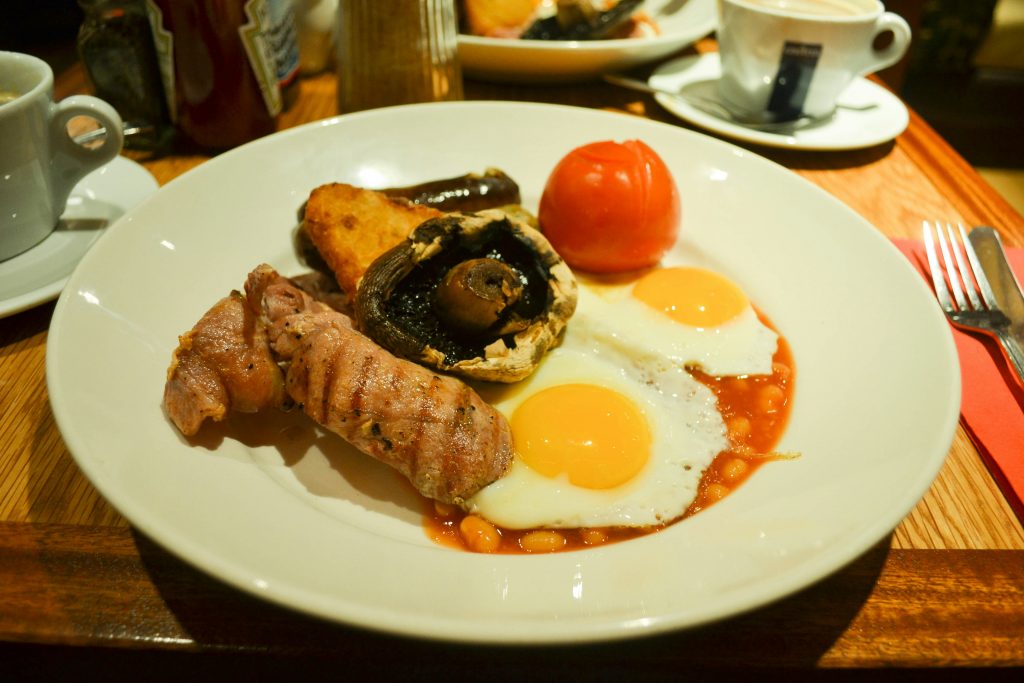
I can’t speak for the whole populace, but, traditionally, the staples of a British breakfast would be cereal and toast, or a “full English” if you have time and are feeling particularly hungry. (Think a plate of eggs, sausages, bacon, tomatoes, mushrooms, etc.) Although you can now find pancakes or muffins on breakfast menus in some cafés and restaurants, those items wouldn’t generally be what your characters would start the day with at home, especially in a historical context. This has led to me replacing blueberry muffins with toast and marmalade in a 1920s’ mystery, for example.
Sometimes authors will know about British foods but perhaps not know when they would be eaten, so on another occasion I’ve replaced scones at breakfast also with toast. Although scones are a wonderful British food, they’re more afternoon tea fare and wouldn’t be found on a standard breakfast table. And lastly, I can’t leave this section without mentioning the classic faux pas that horrifies British readers: cream is never added to tea; it’s always milk.
There are many other areas that I could talk about, such as flora and fauna, place names, customs, buildings, and aspects of daily life, but we’ve run out of time. However, I hope that what we’ve discussed has given you a flavour of the topic. Each book and individual author brings something different that needs tweaking or changing to give the most authentically British characters and setting. It’s a privilege and a pleasure to work alongside writers in this area, and I enjoy playing this small part in the creative process of writing a book.

Heather Belleguelle
I’m Heather Belleguelle, and through my business, Behest Fiction Editing, I work with indie authors, providing copyediting, proofreading and British authenticity reading. I specialise in cozy mysteries and police procedurals but also enjoy a bit of romance and inspirational or book club fiction.
I live with my husband and the guide dog puppy we’re currently raising in beautiful Northumberland, where we enjoy walks in the countryside or on the local beaches. In my leisure time, I can also often be found researching my family history or reading a novel. When (or if!) Puppy settles for the evening, my husband and I like to watch detective dramas or sports whilst indulging in a little dark chocolate.